THE MERCHANT OF VENICE
by William Shakespeare
by William Shakespeare

Owen Warr and John Lott
Tue 7 - Sat 11 December 1993
Northampton College Arts Centre, Booth Lane, Northampton
CAST & CREW
Antonio John Cartwright
Salerio Richard Allen
Solanio/Clerk of the Court Duncan Eaton
Lorenzo John Musson
Bassanio David Ufton
Gratiano Martin Borley
Shylock John Lott
Launcelot Gobbo John Hendy
Old Gobbo/Tubal Owen Warr
Jessica Gina Lander
Duke of Venice/Waiter Michael Gallant
Prince of Arragon/Officer of the Court Jason Haigh
Portia Denise Swann
Nerissa Patricia Coleman
Balthazar John Clarke
Prince of Morocco Richard Walker
Singer Liz Clark
Stephano Kieron Whitehouse
Director George Hammerschmidt
Stage Manager Charles Cartwright
Stage Crew Greta Hendy, Emma Lindifferent, Rosemary Middleton, Graeme Osler, Karen Seelig, Martin Thursby
Properties Ann Greenaway
Set Derek Banyard
Lighting Richard Walker
Wardrobe & Masks Alison Dunmore with help from Liz Clark, Joy Eason, Pam Stenson, Ann Stirland
Make-up and Hair Elaine Geeson
Portia’s make-up and Hair Susie Lawley Wakelin
Prompt Emma Austin
Music composed by Tony Gosling
Musical Director Peter Garvey
Guitar Nadra Choveiri
Clarinet Samantha Cullen
Violin Katherine Vallence
Photo gallery
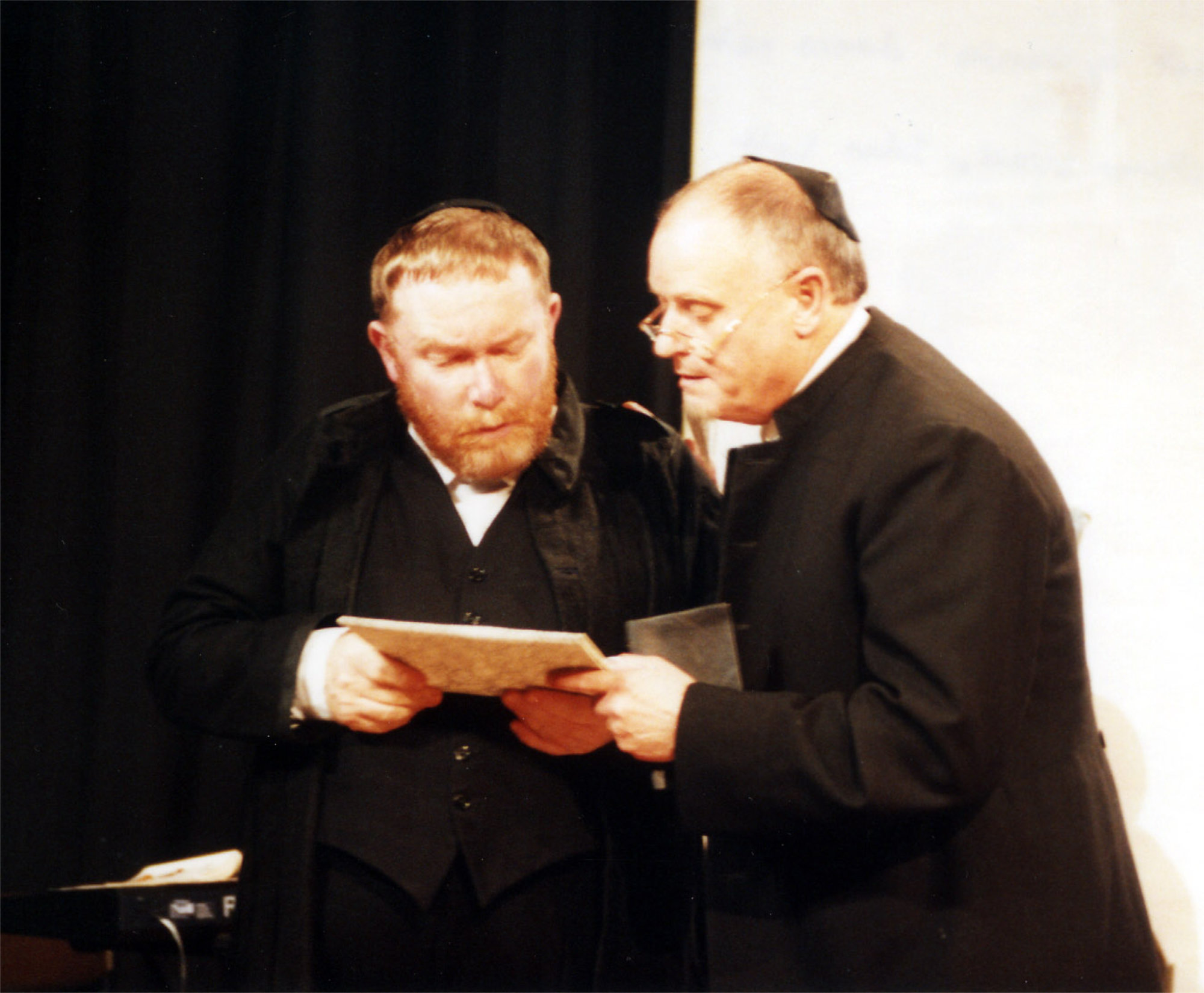


The Merchant of Venice is a gripping play which enthrals its audience. Although listed as a comedy, there are elements which can be thought-provoking for theatre-goers with issues of justice and racial discrimination explored.
The Masque Theatre group was challenged and the many fast, short scenes were signified by a set of three triangular blocks which when rotated depicted various locations.
Although unexciting and basic, they informed the audience of where characters were. However, scene changes were slow and laborious, rescued in part by musicians playing a rustic ballad intended to divert attention.
The costumes served a purpose of distinguishing who was who, the masks scene being especially colourful with cloaks of red, green and gold.
The language of Shakespeare can be difficult to decipher but the delivery was clear and precise, enabling the audience to easily follow the plot.
Performances worth mentioning were by John Lott (Shylock), who was outstanding in his range of emotions. Patricia Coleman and Martin Borley, the second set of lovers, complemented each other and were not only humorous but believable and the two wooing princes - who delighted the audience with their foolish antics.
A difficult play held together by these performances.
Second only to Hamlet, The Merchant of Venice is Shakespeare"s most frequently performed play.
It has fascinated actors and audiences for four hundred years, most probably because of that controversial character, Shylock, the Jew.
Despite the play's title (the eponymous hero being the merchant, Antonio) it is Shylock who, “many a time and oft”, has hijacked productions. The play is listed among Shakespeare‘s comedies but so often it is the power and the poignancy of the courtroom drama which audiences recall long after the memories of the lovers“ poetry and banter, their deceptions and reconciliations have faded. Indeed, it was not uncommon, in the eighteenth and nineteenth centuries, for the last act to be entirely cut because it was regarded as an anticlimax alter the tensions of the trial scene.
It is likely that Shakespeare had never met a Jew. They were banished by Edward I and in Shakespeare’s day there were probably no more than a hundred of them in England, mostly living, at least outwardly, as Christians. It was customary for them to be portrayed on stage as comic villains, wearing grotesque ginger wigs and huge false noses. Audiences may well have jeered them, much as they do demon kings in today’s pantomimes. History has made it impossible to approach Shylock in a way familiar to Elizabethan audiences.
Shylock is vilified for profiting from lending money — an activity that was condemned by the Church as sinful. This seems a quaint notion today when lending money for gain has become universal and institutionalised and when even the Vatican has its own bank!
Antonio lends money to Bassanio (and to many others) for the sake of friendship. The amount at stake in this play is 3,000 ducats, reckoned to be today's equivalent of around £20,000, some indication of how highly the Elizabethans regarded the notions of generosity and friendship.
And what of justice, so defiantly demanded by Shylock and so deviously dispensed by Portia? The legal trickery, which could never carry weight in any real court, and the subsequent humiliation of Shylock, makes to-day’s audiences uncomfortable but, in the light of the Elizabethan attitude towards stage Jews. it was then probably enjoyed with delighted cheers.
Ideas about money lending, friendship and the rights of racial minorities have changed since I598 and yet so vividly has Shakespeare drawn his characters and so well does the plot move from scene to scene that The Merchant of Venice continues to grip and to delight audiences today as much as ever it did.